








Mahjong: A Players Guide
How To Enjoy and Win The World's Most Widely Played Tile Game.
This guide covers the Hong Kong / Cantonese rules version of the game.
Mahjong is a fast paced, social tile game for four players who draw and discard tiles to complete a winning hand of four sets and one pair. This guide focuses on Hong Kong Mahjong, the most widely played version and one of the most beginner friendly rulesets.
Hong Kong rules are straightforward; the scoring system uses simple fan values, and gameplay flows naturally. Whether you are a complete beginner learning the fundamentals, a casual player tightening up your decisions or an aspiring competitive player looking for clear explanations, the foundation remains the same whether you play at home, in an Asian casino or through a digital Mahjong app.
This guide takes you from absolute beginner to confident player. You will learn Mahjong's origins and major variants, the tile types, how to set up the table, how a round flows, how winning hands are built, how Hong Kong scoring works, practical strategy, defensive play, common mistakes, example hands, drills, advice on choosing real money Mahjong games and a clear FAQ.
So, what is Mahjong and why do so many people enjoy playing it?
Mahjong is a four player game played with tiles instead of cards. Each player draws tiles, discards tiles, and aims to complete a winning hand consisting of four sets and one pair. A set can be a Chow (a run of three suited tiles), a Pung (three identical tiles) or a Kong (four identical tiles).
Beginners enjoy Hong Kong Mahjong because the basic pattern of four sets plus a pair is easy to understand, tile recognition improves naturally with practice, scoring is simpler than many other variants and the gameplay develops a steady, satisfying rhythm. Digital Mahjong apps and online Mahjong style games make it easy to practise tile recognition and hand structure before you ever sit at a live table. Mahjong combines tradition, strategy and social play in a way few games do, which is why it remains a cultural fixture in China, a competitive discipline in Japan, a popular table game in the West and a live or online challenge for players who want a rewarding game of skill and chance.

Mahjong: History of Mahjong, the Modern Era, the Online Era, Popular Variants, Culture and Tradition, Tiles & Sets, Sound and Feel, Basic Rules, Walkthrough, and How to Set Up a Game
Mahjong Players Guide
A Brief History of Mahjong
Origins in China
Though Mahjong appears to be an ancient game, most historians date it to 19th-century China, during the Qing dynasty. Early forms of the game probably developed from card and domino games such as “Madiao.” The game quickly spread through port cities such as Shanghai, Tianjin and Ningbo, eventually becoming a favourite national pastime. The first Mahjong sets date back to around 1870.
Mahjong Goes Global
In the 1920s, Mahjong had made its way across the oceans. Exported sets introduced the game to the United States and Europe, where it was taken up by fashionable society and became a craze among the wealthy elite. In the United States, Mahjong developed a following among the Jewish-American community.
Regional Styles
As Mahjong became popular all over, regional variations were formed:
• Hong Kong & Guangdong: Fast rules that are popular in Southern China.
• Japanese Riichi: Focuses on strategy, betting sticks and dramatic winning announcements.
• Taiwanese Mahjong: Larger playing hands containing more tiles.
• American Mahjong: Includes special Joker tiles and a local rules card.
Mahjong in the Modern Era
By the turn of the 20th century, Mahjong was a cultural ritual and glamorous entertainment. Today it's a favourite at family gatherings, a professional sport in Japan, and a casino game in gambling meccas such as Macau and Las Vegas. In 2019, China restricted household mahjong games due to gambling.
Mahjong in the Online Era
The digital era has brought Mahjong a new lease of life, spanning traditional multiplayer play and single-player mahjong solitaire online.
• Mobile Apps: Casual doubles games played by millions on phones and tablets, often on a mobile device after a quick download from google play, and many are free.
• Online Casinos: The clatter of tiles is brought into the homes of players across the globe with live-dealer Mahjong tables.
• Esports: Riichi Mahjong has also entered the world of esports in Japan and is gaining new, younger fans.
It's great for sharpening beginners' skills. Tutorials, low-stakes games, and glamorous live-streamed casino tables are all now available online. Remember to try to play in landscape mode.
Popular Variants of Mahjong and Mahjong Solitaire
Part of Mahjong’s appeal is its variety:
Chinese Mahjong (Hong Kong Rules)
• classic Mahjong. Brisk rounds, simple scoring, played almost everywhere in Southern China and the casinos of Macau.
Japanese Riichi Mahjong
• A more strategic style of play where players use sticks to bet, build “riichi” hands, and go for considerable value and dramatic wins. Riichi Mahjong is cool in its own way, as it’s on television, has celebrity players, and a dedicated fan base.
American Mahjong
• American Mah Jongg, developed in the 1920s, requires a hand card issued annually by the National Mahjong League (NMJL) and includes 8 Joker tiles. It features special combos and follows the National Mah Jongg League rules card, making it especially popular in the US as a social and casual game.
Taiwanese Mahjong
• Uses 16-tile hands (not 13), implying more intricate strategies and longer games.
Every version has its own twist, but all retain the essence of Mahjong: striving for a complete, harmonious hand.
Mahjong in Culture and Tradition
Mahjong is not just a game; it’s a cultural Symbol.
Family Tradition
• Mahjong is a fixture in China during festivals such as the Lunar New Year. The family sits around the table, passing around snacks and tea and chattering. For some, it represents luck, wealth, and companionship.
Professional & Celebrity Play
• It is a competitive sport in Japan, with professional Riichi players, leagues being broadcast before a live audience, and players reaching celebrity status. Some even enjoy the kind of fame that poker champions enjoy in the West.
Casinos & High Rollers
• High rollers in Macau’s high-end casinos still enjoy playing Mahjong. Private VIP rooms draw high-stakes games where a fortune can be made or lost, adding to the aura of prestige and exclusivity that already surrounds Mahjong.
Pop Culture
• Mahjong is featured in many films, books, and TV shows, from Hong Kong cinema to Hollywood dramas. It’s visual shorthand for Asian culture, game play, and cool.
Mahjong Tiles & Sets Explained, Including Flower and Season Tiles
A standard Hong Kong Mahjong set contains144 tiles. These are divided into suited tiles, honour tiles and bonus tiles.Learning to recognise these groups is the first step to playing comfortably.
Standard Set:
• There are 144 tiles in the Mahjong set
• Suits (108 tiles):
• Bamboo (Bams): stylised representations of bamboo.
• Characters (Craks): The Chinese characters for numbers.
• Circles (Dots): circular form which looks like a coin.
• Each suit is numbered one through nine, and four copies of each tile are included.
Suited Tiles: Dots, Bamboo, Characters, and Winds
Suited tiles behave a little like suits in a deck of cards. There are three suits, each numbered from 1 to 9:
Dots (or Circles) represent coins.
Bamboo (or Bams) are sticks, with the 1 Bamboo usually shown as a bird.
Characters are Chinese characters for the numbers 1 to 9.
Suited tiles can form both Chows (runs suchas 3–4–5) and Pungs (triples such as 7–7–7). They form the backbone of most winning hands.
Honour Tiles (28 tiles):
• Winds: East, South, West, North.
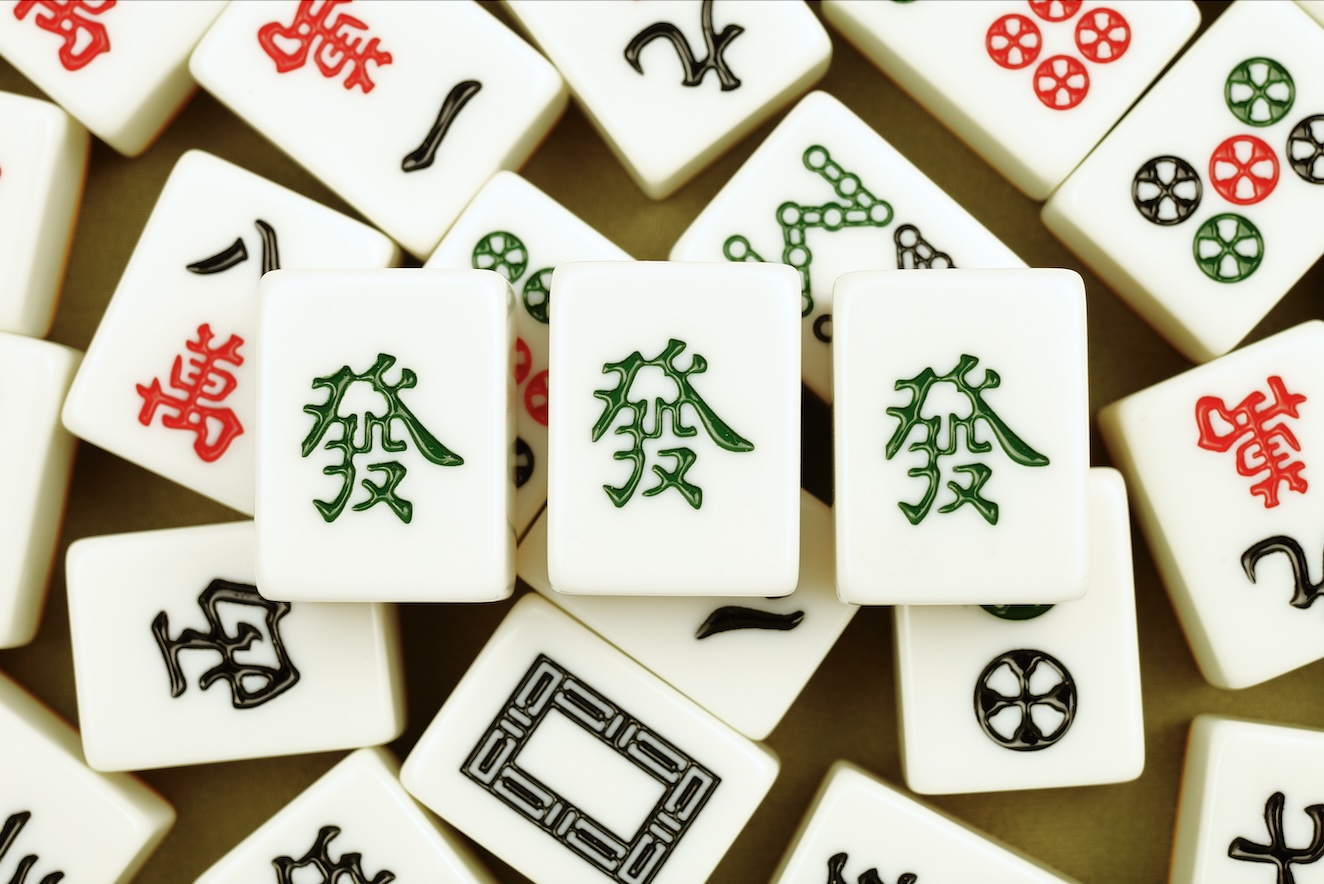
• Dragons: Red (wealth), Green (prosperity), White (purity).
Honour Tiles: Winds and Dragons
Honour tiles do not form runs, only Pungs and Kongs. There are two groups:
• Winds: East, South, West and North.
• Dragons: Red, Green and White.
Wind and Dragon Pungs are important for scoring because they often carry fan. Your own seat wind and the prevailing wind for the round can each add extra value.
Bonus Tiles (8 tiles, optional):
• Flowers and Seasons are just decorative, but grant bonus points when drawn.
Bonus Tiles: Flowers and Seasons
Bonus tiles consist of four Flowers and four Seasons. When you draw one, you place it face up in front of you and draw a replacement tile from the dead wall. These tiles do not form part of your sets, but they add bonus points at the end of the hand. Beginners can ignore Flowers and Seasons at first and add them later when the core game feels natural.
The Sound and Feel
One of the fun things about Mahjong is the clatter of the tiles as they’re shuffled into the “wall” before play. It’s iconic and as much a part of the game’s allure as the gameplay itself.
Basic Rules & Objective
Though the rules may differ from one part of the world to another, the basic gameplay usually remains pretty much the same:
Objective
Create a full hand, typically four sets and a pair. A set can be:
• Pong: three identical tiles.
• Chow: a straight sequence of three tiles of the same suit.
• Kong: four identical tiles.
• Pair: two identical tiles.
In Mahjong, players earn points based on tile pairings.
Setup
• Each player starts the game with 13 tiles.
• Players then take turns drawing a tile from the wall and discarding one. Players aim to improve their hand, with the goal of being the first to complete a winning hand.
• The objective is to complete a 14-tile winning hand. A standard Mahjong hand consists of four sets of three tiles (either Pungs, Chows, or Kongs) and a pair, totaling fourteen tiles.
Declaring Mahjong
• A Player announces “Mahjong!” when they complete their hand and then reveal their tiles for confirmation. The round is then completed, and points are awarded.
Beginner Walkthrough
• Shuffle and build the wall.
• Deal 13 tiles to each player.
• On your turn, draw one of the tiles and decide if it's what your hand needs, discarding another.
• An opponent can claim a discarded tile to form a Pong, Chow or Kong.
• Keep going until someone makes a legal winning hand, puts all the tiles down, and yells Mahjong!
• Games can last around four hours with four players.
How to Set Up a Mahjong Game
Building the Wall
Before starting a game, players must shuffle the Mahjong tiles and build a wall of tiles that is 18 tiles long and 2 tiles high in front of each player. All tiles are placed face down in the centre of the table and thoroughly mixed. Each player then builds a wall in front of themselves, two tiles high and seventeen tiles long, consisting of a top row and a bottom row of tiles. Together, the four walls form a square block of tiles around the table edge. This is the Mahjong wall that players will draw from during the hand.
Determining the Dealer (East)
At the start of a session, the dealer position, known as East, is chosen at random, often by dice. To determine the dealer and seating arrangements, players can roll dice, with the highest roll becoming the dealer, who is assigned the East position. Players are then assigned wind positions, East, South, West, and North, around the table, with the dealer taking the East wind. The dealer has scoring advantages and continues as East if they win a hand. If someone else wins, the dealer position usually rotates.
Breaking the Wall
To begin a hand, East rolls the dice. The number rolled determines where the wall is broken, and this can include the south wall depending on the result. Counting from East’s right, the required number of stacks is skipped and the wall is opened at that point, sometimes at the south wall if indicated by the dice. Tiles to the right of the break form the live wall from which players draw.
Dealing Tiles
Tiles are dealt in sets of four tiles from the wall to each player, typically taken from the top row. Each player continues to take tiles in sets of four until everyone has twelve tiles. East then takes two extra tiles for a total of fourteen, while the other three players each take one extra tile for a total of thirteen. After the deal, East makes the first move by discarding a tile face up into the centre, this is known as East's discard, to start the first turn. If a bonus tile such as a Flower or Season is drawn, it is set aside and replaced with a new tile from the dead wall. From this point, all players effectively hold thirteen tiles until they win.
Mahjong: Basic Mahjong Gameplay, How Winning Works, Scoring: The Fan System, and A quick reminder
Basic Mahjong Gameplay Explained
The Turn Structure
Each turn in Mahjong follows a simple pattern:
- The player draws a tile from the wall.
- Evaluate your hand.
- Discard a tile face up into the centre.
You normally draw tiles from the wall. However, if another player discards a tile that can complete a legal set for you, you may be able to claim it instead of drawing from the wall, depending on what you are trying to form and where you sit. After a discard, play continues to the next player.
Drawing Tiles
Most of the time you draw from the wall, taking the next tile from the live end of the wall. Occasionally you will draw from the dead wall if you have formed a Kong and need a replacement tile. Drawing from the wall keeps the turn order intact and is the quiet, standard way that hands progress. The last tile in the wall holds strategic importance, as it represents the final opportunity to complete a winning hand before the game ends.
Calling Tiles: Chow, Pung and Kong
Chow
A Chow is a sequence of three suited tiles in numerical order, such as 3–4–5 Dots or 7–8–9 Bamboo. You can only claim a discard to complete a Chow from the player directly to your left. When you call a Chow, you announce it, take the discarded tile, combine it with the two matching tiles from your hand, and place the three tiles face up. Your hand becomes partly open and you then discard one tile as normal.
Pung
A Pung is a set of three identical tiles. Pungs can be made from suited tiles, Winds or Dragons. When you claim a discard to complete a Pung from any other player, you call Pung, take the discard, and expose the three matching tiles in front of you, this is called an exposed pung. An exposed pung is visible to all players and can be used strategically. After exposing the pung, you discard a tile from your hand.
Kong
A Kong is a set of four identical tiles. There are several ways to form one:
• Exposed Kong from a discard: if you have an already exposed pung and another player discards the fourth tile, you may call Kong, add the fourth tile to your set, reveal all four, and draw a replacement tile from the dead wall.
• Concealed Kong: if you draw all four identical tiles yourself, you may declare a concealed Kong, reveal them according to house rules and draw a replacement tile.
• Added Kong: if you have a concealed Pung and later draw the fourth matching tile, you may upgrade to a Kong and draw a replacement tile.
Each Kong uses one tile from the dead wall as a replacement draw. Kongs often add fan and can be powerful scoring components, but creating them also reveals a lot of information about your hand to the table.
Calling Priority
If more than one player wants to claim the same discard, there is a strict order of priority:
1. A player who can win with that tile by declaring Mahjong takes priority.
2. Any player who can use the tile for a Pung or Kong has priority over a Chow.
3. Only if no one can win and no one wants to Pung or Kong may the player to the left of the discarder claim the tile for a Chow.
This priority structure ensures fairness and affects how risky certain discards become as the hand develops.
When You Should and Should Not Call
Calling a tile can speed up your progress but reduces the flexibility of your hand because exposed sets cannot be rearranged. Beginners often call too aggressively, freezing their structure and making it harder to complete a hand.
You should consider calling when:
• The tile completes a stable set that fits your overall shape.
• You are close to winning and the call pushes you into tenpai, one tile away from victory.
• The tile is an honour or terminal that may be hard to see again.
• You are deliberately aiming for a fast, low fan winning hand.
You should avoid calling when:
• Your hand is flexible and forming smooth sequences naturally.
• Taking the call forces you to break up efficient shapes.
• You are still far from a complete structure.
• You want to keep opponents guessing about how close you are to winning.
A simple beginner rule is: if your hand feels smooth and open, resist calling. If your hand feels messy or behind, a well chosen call can stabilise it.
How Winning Works in Hong Kong Mahjong
Standard Hand Structure
A standard winning Hong Kong Mahjong hand almost always consists of four sets plus one pair. Sets are Chows, Pungs or Kongs, and the pair is two identical tiles that do not form part of any set. Most of your learning revolves around building and recognising this four sets plus one pair pattern.
Winning by Self Draw and by Discard
You can win in two ways:
• Self draw (zimo): you draw the winning tile from the wall yourself. This usually earns extra fan.
• Discard win: another player discards the tile you need and you claim it immediately by declaring Mahjong.
Both are valid, but self drawn wins are slightly more valuable and do not rely on your opponents’ mistakes.
Examples of Complete Winning Hands
Example 1 – Balanced hand:
• 3–4–5 Bamboo (Chow)
• 7–8–9 Dots (Chow)
• Red Dragon Pung
• West Wind Pung
• Pair of 6 Characters
Example 2 – Dragon heavy hand:
• Red Dragon Pung
• Green Dragon Pung
• White Dragon Pung
• 4–5–6 Characters (Chow)
• Pair of 9 Bamboo
Example 3 – Concealed hand:
• 2–3–4 Bamboo (Chow)
• 5–6–7 Bamboo (Chow)
• 3–4–5 Dots (Chow)
• Red Dragon Pung
• Pair of 5 Characters
These examples all follow the four sets plus one pair structure but use different mixes of suited sets and honours. The more you study complete hands, the easier it becomes to see how your own tile scan grow into a winning pattern.
Wait Types: How Your Hand Becomes Ready
When your hand is one tile away from winning, you are in tenpai. The kind of tile you need is called your wait. Knowing your wait type helps you judge how likely you are to complete the hand.
• Edge wait: you need a 3 to complete 1–2–3 or a 7 to complete 7–8–9.
• Closed wait: you need the middle tile to complete a run, such as 4 in 3–5.
• Double sided wait: you have 4–5 and can win on either 3 or 6.
• Pair wait: your final tile needs to complete your last set and your pair.
• Single tile wait: you need a specific tile to form your final pair.
Double sided waits are the most efficient because they give you two possible tiles to complete the hand. Single and closed waits are weaker but still common, especially in hands built around honours.
Hong Kong Mahjong Scoring: The Fan System
What Fan are
Hong Kong Mahjong uses a fan based scoring system. Each scoring feature or pattern adds a number of fan to your hand. As fan increase, the payout grows, often doubling at each step. A table will usually set a minimum fan requirement for a winning hand, commonly one or two fan.
Common One Fan Patterns
Some of the most common one fan patterns include:
• Dragon Pung.
• Pung of your seat wind.
• Pung of the prevailing wind.
• Concealed hand.
• Self drawn win.
• All Chows (a hand made entirely of Chows and a pair).
Common Two Fan and Higher Patterns
Examples of higher value patterns include:
• Pungs of terminals (1s and 9s).
• Two Dragon Pungs.
• All Pungs (a hand made entirely of Pungs or Kongs).
• Pure Straight (1 through 9 in one suit achieved across three Chows).
• Half Flush (hand using one suit plus honours).
• Full Flush (hand using only one suit, often higher fan).
Limit Hands
Some hands are so rare and powerful that they are treated as limit hands, scoring the maximum allowed points regardless of the exact fan count. Examples in Hong Kong style include:
• Thirteen Orphans.
• Big Four Winds.
• Big Three Dragons.
• Nine Gates.
• All Terminals.
• All Honours.
Beginners do not need to chase these patterns. They will appear naturally from time to time as you gain experience.
How Fan Convert to Points
Exact scoring tables vary between groups and casinos, but a common structure doubles the base payment at each extra fan. For example:
• 1 fan = base payment.
• 2 fan = base × 2.
• 3 fan = base × 4.
• 4 fan = base × 8.
• 5 fan = base × 16.
The dealer position has a strong effect on scoring. East usually pays double when losing and receives double when winning. In many groups, when East wins by self draw, all three other players pay them, which creates swingy but exciting rounds.
A player's score can vary significantly based on regional rules, with some hands being worth more points than others depending on their complexity and the tiles used.
A quick reminder, Beginner Tips
• Learn the Tiles First: Hone your ability to remember suits and honours; it will help you to play faster, and with more confidence.
• Mahjong gameplay proceeds counterclockwise around the table.
• Don't Hoard: Beginners tend to hold too many options. Focus on completing specific sets.
• Watch Discards: See what others are trashing, as it tells you what they're building.
• Stay Flexible: Do not lock into one strategy too early; adapt as the game progresses.
• Budget Your Play: In a gambling setting, always set limits. Like poker, Mahjong can be intense, but part of its mastery lies in pacing yourself.
• Players should keep track of tiles discarded by opponents to inform their strategy.
• Honours in Mahjong include Winds and Dragons.

Mahjong: Beginner Mahjong Strategy, FAQ, Glossary, Pre Play Checklist, Practice Drills for New Players, Choosing Your First Real Money Game, and Conclusion
Beginner Mahjong Strategy
Mahjong strategy balances speed, hand quality and risk control. Unlike games with fixed patterns, you must adapt to the tiles you draw and the way other players behave. Good beginner strategy focuses on building efficient shapes, avoiding unnecessary danger and knowing when to push for a win or step back and defend.
Tile Efficiency Basics
Tile efficiency is the art of keeping your hand as flexible as possible so that many different draws can improve it. Arranging your own tiles thoughtfully is crucial—organize your tiles to easily spot potential sets like chows, pungs, and kongs, and to quickly respond to discards from other players. A few simple principles help:
• Prioritise open ended shapes like 4–5 and 5–6 over broken shapes like 3–5.
• Discard isolated tiles that do not connect with anything else, especially early in the hand.
• Do not hoard too many pairs. One pair is essential, but extra pairs can clog your hand.
• Keep your options open across suits until it is clear which direction your hand is taking.
Efficient shapes give you more winning tiles and reduce the number of awkward, dead tiles that sit in your hand doing nothing.
Another quick reminder, When to Call and When to Stay Concealed
Calling tiles makes your hand faster but more rigid. A fully concealed hand is often worth extra fan and keeps your true shape hidden. Beginners should lean toward staying concealed when their hand develops smoothly and only call when a tile truly improves their overall position or brings them close to tenpai.
Push or Fold Logic
Push or fold decisions become crucial as the wall shrinks and the chance of someone winning increases. You should push when you are close to winning, your discards remain relatively safe and your hand has a realistic path to completion. You should fold when an opponent clearly has a strong open hand, the round is late, and you are still far from a viable structure.
Folding in Mahjong often means deliberately discarding tiles that are already visible on the table or otherwise unlikely to complete an opponent’s hand, even if those tiles do not help your own hand. Survival is sometimes the correct strategy, especially when you are already ahead in points or when dealing into a big hand would be very costly.
Identifying Safe and Dangerous Tiles
Safe tiles are those that are unlikely to complete an opponent’s winning hand. Dangerous tiles do the opposite. General guidelines include:
• Tiles that have already been discarded multiple times are usually safer.
• Honour tiles that are all visible (in discards or open sets) are safe.
• Terminals and honours can be dangerous earlier in a hand but safer later if many have appeared.
• Middle suit tiles around exposed sequences can be risky, especially 4s, 5s and 6s.
• Discarding or collecting other tiles that are not part of your main hand-building strategy can impact both your ability to form sets and your defensive play, so consider how these other tiles affect your options and your opponents’ potential hands.
Beginners improve quickly by thinking about the risk level of each discard instead of discarding only based on their own hand.
Reading Opponents
Even at a casual level, paying attention to other players makes a big difference:
• Count how many sets each player has exposed.
• Notice which suits they avoid discarding.
• Watch for sudden changes in discard patterns that suggest a shift in hand structure.
• Pay particular attention to the player on your left, who can Chow from your discards.
By combining discard information with exposed sets, you can often guess whether an opponent is close to winning and adjust your aggression accordingly.
Early, Mid and Late Game Strategy
In the early game, focus on building flexible shapes and discarding honours and isolated tiles that do not fit your plan. In the mid game, begin committing to a structure, making selective calls if they clearly help. In the late game, assess whether your hand can realistically win. If not, shift to defence and prioritise safe tiles over ambitious pushes.
Common Beginner Mistakes
Recognising common mistakes helps you avoid them:
• Calling too many tiles and freezing your hand into a low flexibility structure.
• Holding single honours for too long instead of discarding them early.
• Chasing high value patterns instead of completing solid low fan hands.
• Ignoring discard information from other players.
• Refusing to fold in dangerous late game situations.
• Discarding obvious winning tiles into open, strong hands.
Avoiding these errors gives you a big edgeover other new players and creates a calmer, more controlled, and comfortable playing experience.
FAQ
Q: Is Mahjong mostly luck or skill?
A: Both. Luck determines the tiles you draw, but skill determines how efficiently you use them, when you call, when you defend and how you read other players.
Q: Do I need to memorise every scoring rule?
A: No. Start by learning the common one fan and two fan patterns. Rare limit hands will become familiar over time.
Q: How long does it take to learn Mahjong?
A: Most people understand the basic flow in an hour or two. Developing strong strategy and defensive awareness takes many sessions, but improvement is steady.
Q: Is Hong Kong Mahjong easier thanJapanese Riichi Mahjong?
A: Yes. Hong Kong rules use a simpler scoring system and fewer restrictions, which makes them ideal for beginners.
Q: Can I practise Mahjong online?
A: Yes. Digital Mahjong and Mahjong-style games are excellent for learning tile recognition, hand structure and basic scoring without the pressure of a live table. It also helps to distinguish traditional four-player rules from solitaire formats, since you can play Mahjong online against others or practise solo with Mahjong Solitaire.
Q: What is the biggest mistake beginners make?
A: Over calling tiles and freezing their hands, which reduces flexibility and makes it harder to complete a hand.
Q: When should I fold a hand?
A: Fold when an opponent clearly looks close to winning, the round is late and continuing to attack would mean discarding risky tiles that could complete their hand.
Beginners Glossary
• Chow: a sequence of three suited tiles in numerical order.
• Pung: three identical tiles.
• Kong: four identical tiles.
• Pair (Eyes): two identical tiles used to complete a winning hand.
• Tenpai: one tile away from a legal winning hand.
• Zimo: winning by self drawing the final tile from the wall.
• Discard win: winning by claiming another player’s discard.
• Discarded tile completes: when a discarded tile allows another player to complete a set (such as a pung or kong), often triggering specific rules for claiming or playing out of turn.
• Dealer (East): the player in the East seat, who wins and loses double.
• Dealer wins: if the dealer wins a hand, they retain the dealer position for the next game, potentially extending their turn as dealer.
• Prevailing Wind: the wind assigned to the current round of play.
• Wind tiles: honor tiles representing East, South, West, and North; used for seating arrangements, scoring, and forming sets. They are important for determining prevailing winds and scoring rules.
• Dragon tiles: honor tiles (Red, Green, and White dragons) that are significant for scoring, especially when forming valuable sets like pungs or kongs.
• Season tiles: special bonus tiles (Spring, Summer, Autumn, Winter) that can be set aside for extra points; their use is often optional and may depend on house rules.
• Flower and season tiles: special bonus tiles that must be immediately exposed upon drawing and replaced with a tile from the dead wall. They can influence gameplay and scoring, but are sometimes excluded to simplify the game.
• Dead Wall: a reserved portion of the wall used for replacement tiles after Kongs.
• Limit hand: a rare, high value hand awarded maximum points.
• Fan: the scoring unit used to value hands in Hong Kong Mahjong.
• Mixed suits: a hand containing tiles from multiple suits (dots, bamboo, characters), typically with no scoring value unless allowed by house rules.
• Safe tile: a tile that is unlikely to complete an opponent’s hand.
• Dangerous tile: a tile that is likely to complete an opponent’s hand.
• Wall: the square block of stacked tiles from which draws are made.
• Rule book: the official or legal guidelines for playing mahjong, including procedures and specific rules such as the Charleston.
• Same number: each player should start with the same number of scoring sticks to ensure fairness and consistency.
• Next game: the subsequent round or match that begins after the current hand concludes, with roles and positions adjusted as needed.
• Same player: refers to the dealer or position remaining with the same player under certain conditions, such as when the dealer wins a hand.
• Certain rules: predefined guidelines or regulations that determine when and how multipliers or other mechanics are applied during gameplay.
Beginner Pre Play Checklist
Before you play a full game, make sure you can:
• Recognise all suits, winds and dragons at a glance.
• Understand that a winning hand is four sets plus one pair.
• Know when you are allowed to call Chow, Pung or Kong.
• Recognise at least the common one fan patterns.
• Watch discard piles and open sets from other players.
• Set a comfortable session budget if playing for real money.
• Take regular breaks so that decisions stay calm and clear.
Practice Drills for New Players
Drill 1: Tile Recognition.
Lay out random tiles from a set or use an app. Name each tile and identify its suit or honour group. Repeat until you recognise tiles instantly.
Drill 2: Shape Evaluation.
Deal yourself thirteen random tiles and practise finding potential sets and flexible shapes. Identify which tiles are isolated and which groups are most efficient.
Drill 3: Observation Only.
Watch a live or digital Mahjong game without playing. Track discards, notice how often players call and pay attention to which tiles seem dangerous late in the hand.
Drill 4: Safe Tile Identification.
During play or practice, pause before each discard and ask whether the tile is safe or dangerous and why. Over time, this habit strengthens your defensive instincts.
Drill 5: Scoring Breakdown.
After each completed hand, whether you win or someone else does, write down the main scoring features and total fan. Seeing this repeatedly helps cement scoring knowledge and awareness of common patterns.
Choosing Your First Real Money Mahjong Game
Many beginners start with digital Mahjong or Mahjong style games because these platforms handle scoring automatically and highlight legal moves, which reduces confusion. Online games often allow slower, low stake play and let beginners play mahjong in low-stakes rooms before moving to live tables, giving you time to think through each decision, which is ideal while you are learning.
When you feel ready, you can explore live Mahjong tables at social clubs or dedicated venues. These bring the full social side of Mahjong to life and reward the skills and habits you have developed online, such as tile efficiency, defensive play and reading opponents. If you prefer to continue playing online, look for UK licensed operators offering Mahjong style content so that you can practise in a safe, regulated environment.
Conclusion
Mahjong can look intimidating at first, but once you understand the tile groups and the flow of drawing and discarding, the game becomes one of the most enjoyable and rewarding forms of social strategy play. Hong Kong rules are particularly suitable for beginners thanks to their simple scoring system and flexible hand structure.
You now have a complete beginner’s framework: you know the tiles, the setup, how a round flows, how winning hands are built, how the Hong Kong fan system works, basic and defensive strategy, common mistakes to avoid and practical drills to keep improving. With a little practice, you will find that patterns start to appear naturally and your decisions feel more confident.
When you are ready to put this knowledge into practice, starting on low stake digital Mahjong tables or Mahjong style games at reputable UK licensed operators can offer a calm, controlled way to turn theory into experience.
Pick up your welcome bonus and try Mahjong at an online casino of your choice.
www.casinojester.co.uk

Mahjong: Additional Strategy Examples and Deep Dive Scenarios
To help close the gap between understanding Mahjong theory and applying it in real play, this extended strategy section provides more detailed walkthroughs of hand development, risk management and opponent reading. These examples aim to show how small decisions made early can influence the entire hand, especially as players approach the late-game phase.
Scenario 1: Building an Efficient Hand from a Weak Start
Imagine your starting hand contains a scattered mix of 1s, 9s and honours, with only one or two tiles that naturally form flexible shapes. Many beginners freeze in this situation, but the key is to simplify. Start by identifying tiles that have no realistic future, such as lone honours that do not match your seat wind or prevailing wind. Discard these first. Next, look at your suits. You may find that one suit contains more tiles than the others, even if they do not yet form clean shapes. Use the early turns to streamline into two or even one suit. This gradual consolidation creates opportunities for natural sequences to form as you draw more tiles.
Scenario 2: Knowing When to Abandon a Hand
Sometimes, even with good tile efficiency, a hand simply does not come together. Strong defensive play often involves abandoning your original plan. If you reach the mid-game with no clear sets, no pair, and opponents are showing aggressive calls, stop trying to force progress. Shift into defence. Discard tiles already visible on the table whenever possible. Avoid discarding middle suit tiles that could complete a common sequence for opponents. Many beginners lose points by stubbornly pursuing a hand that has no realistic path to victory.
Scenario 3: Reading the Wall and Draw Tempo
As the game progresses, the number of available tiles shrinks and the tempo of draws changes. When players make Kongs, more tiles move from the dead wall into circulation, extending the hand and creating more opportunities for surprise wins. If multiple Kongs appear, be careful about discarding tiles that you believe were 'dead,' because the replacement draws may reintroduce winning tiles into the game. Experienced players gently adjust their aggression in these moments.
Extended Scoring Walkthroughs
One of the most challenging parts of Mahjong for beginners is combining scoring elements into an overall fan total. These expanded examples illustrate how different scoring features combine.
Scoring Example A: Simple Concealed Hand
Hand components:
• 2–3–4 Bamboo (Chow)
• 3–4–5 Dot (Chow)
• 6–7–8 Characters (Chow)
• Red Dragon Pung
• Pair of 5 Characters
Fan breakdown:
• Concealed hand: +1 fan
• Dragon Pung: +1 fan
• Self-draw (if applicable): +1 fan
Total: 3 fan
This is a common structure that gives beginners confidence. It's not flashy, but it is a reliable way to produce a winning hand without relying on rare patterns.
Scoring Example B: Half Flush Hand
A Half Flush hand uses one suit plus honours. This is a high-value but achievable scoring pattern.
Hand components:
• 3–4–5 Characters (Chow)
• 6–7–8 Characters (Chow)
• 1 Character Pung
• Green Dragon Pung
• Pair of 9 Characters
Fan breakdown:
• Half Flush: +3 fan
• Dragon Pung: +1 fan
• Pung of terminal (1 Character): +1 fan
Total: 5 fan
A 5-fan hand is strong and typically results in a significant payout, especially if won by self draw or by East. Collecting green tiles, such as the Green Dragon, can contribute to high-scoring or rare hands—certain hands like 'All Green' require only green suit tiles, making them especially valuable. These hands reward players who recognise early when a hand can be streamlined into a single suit.
Scoring Example C: Defensive Win Near the Wall End
In the late game, a defensive win can occur when an opponent discards a tile they believe is safe. Your hand might not be high-value, but the context matters.
Hand components:
• 4–5–6 Bamboo (Chow)
• 2–3–4 Characters (Chow)
• 3–3–3 Dot (Pung)
• West Wind Pung
• Pair of 7 Characters
Fan breakdown:
• Seat Wind or Prevailing Wind Pung: +1 fan (depending on round)
• Pung of suited tile: +1 fan
Total: 2 fan
This win showcases how disciplined defensive play often creates opportunities late in the round.
More Advanced Strategy Concepts for Developing Players
Once you have mastered the basics, you can begin layering more advanced ideas onto your game. These concepts help you anticipate not just which tiles are safe, but how entire suits flow through a hand.
Recognising Suit Dominance
If you notice that two or more players are avoiding a particular suit, it may signal that players are collecting that suit for large hands. When this happens, avoid discarding tiles from that suit unless they have already appeared frequently in the discard pool.
Tile Flow Awareness
Tile flow refers to how tiles tend to cluster. Sometimes many Bamboo tiles appear early, which means that late Bamboo discards are relatively safe. Other times, a suit barely appears, making any discard in that suit dangerous. Keep mental notes of which suits are ‘hot’ and which are not.
Endgame Folding Discipline
Strong players fold early when necessary. If the wall is nearly empty and multiple opponents appear to be in tenpai, you should prioritise absolute safety. Throw only tiles you have seen before or that could not possibly complete common waits. Folding saves far more points over time than beginners expect.
If you are looking to continue your learning, check out some of our other guides, etc. listed below. Enjoy the game and best of luck.
www.casinojester.co.uk
CJ Mahjong Guide
10 Tips To Play Better Mahjong
Top 10 Best Books About Mahjong
Top 10 Biggest Mahjong Tournaments
CJ Travel Guide
Top 10 Best Books About Macau
Top 10 Macau Visitor Attractions
The Top 10 Best Casino Hotels from Around the World
The Top 10 Best Casino Restaurants from Around the World
CJ Casino Review
Genting Casino Review and Current Offers
Hippodrome Casino Review and Current Offers
Betway Casino Review and Current Offers
10Bet Casino Review and Current Offers
CJ Info Guide
Gambling Growth in Asia
CJ Guides
Guides and Reviews Index
SEPTEMBER 2026
Top Features of UK Online Casinos
Playing at our recommended casinos offers an exciting and secure gaming experience. Enjoy generous online casino bonuses, a wide variety of gaming options, and robust security measures.

UK Regulated, secure & trusted

Huge variety of games, jackpots, free spins & bonuses

All casinos offer Responsible gambling tools

Fast, safe & simple deposits & withdrawals

Good Customer Service

Clear & simple design to ease usability
Trusted by top brands in the industry