







Baccarat: The Luxurious History
From Italian Origins to James Bond and Macau High-Rollers
Among all casino games, baccarat is the elegant card game where players bet on whether the player hand, the banker hand, or a tie will win, with the aim of backing the hand closest to 9. Known for centuries as the “game of kings,” baccarat has attracted aristocrats, movie stars, and high rollers alike. Unlike the noisy spin of the roulette wheel or the fast-paced calls of a craps table, baccarat exudes calm sophistication.
For UK based online casino players, whether you’re learning the basics or looking for sharper insight before choosing a UKGC licensed site, baccarat remains worth understanding because it combines a long aristocratic history with easy modern access through online and live dealer tables. From its mystical Italian origins and adoption by French nobility to its starring role in James Bond’s Casino Royale, its rise across Europe, and its dominance in the glittering casinos of Macau and Las Vegas, baccarat has travelled a remarkable path through gambling history.
This guide follows that path from early baccarat to modern online play, including major variants such as Chemin de Fer and Punto Banco, the game’s cultural pull, and what its evolution means for players today. Today, the game is played not only in Monte Carlo and Vegas but also in the palm of your hand via online casino live dealer platforms.
Baccarat: Origins In Italy, Baccarat In French Nobility, and Expansion Across Europe
Baccarat History Guide
Origins in Italy: Felix Falguiere and the Game of Fate
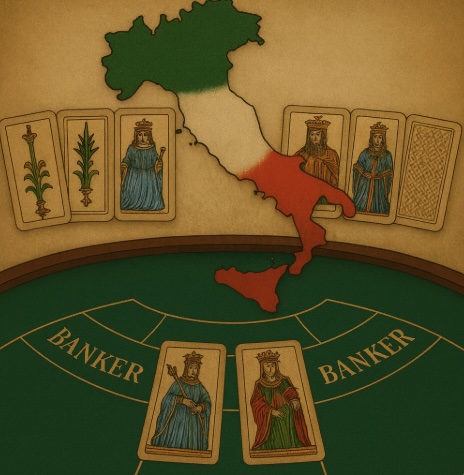
The story of baccarat begins in 15th-century Italy, where a man named Felix Falguiere (sometimes spelt Falguierein) is credited with inventing the game. Baccarat is believed to have originated in Italy in the 1400s, created by Falguiere, who called it “baccara”, meaning “zero” in Italian, as all tens and face cards were worth zero—a unique scoring twist that still defines baccarat today.
According to the Etruscan legend, which is often cited in discussions of baccarat origins, Falguiere drew inspiration from an ancient myth. In this tale, a maiden’s fate was decided by rolling a nine-sided die: if she rolled an 8 or 9, she became a priestess; if she rolled 6 or 7, she could live but without religious honours; and if she rolled below 6, she was destined for exile or death. Falguiere adapted this theme of fate and chance into a card game with the highest possible score of 9, a direct ancestor of modern baccarat.
Played originally with tarot cards, baccara quickly gained a following among Italian nobles. Its mystical aura and simple mechanics made it thrilling and symbolic, representing destiny, luck, and high stakes. The baccarat origins were also influenced by earlier games such as Basset and Faro, which were popular in Europe before baccarat became established. Additionally, early versions of baccarat may have been influenced by the Chinese game Pai Gow, which used dice and had a similar scoring system where the ideal score was nine.
Baccarat in French Nobility: The Birth of Baccarat Chemin de Fer
By the 16th century, baccarat moved across the Alps into France, where it spread in the 15th century and quickly became popular among the aristocracy. It was especially favored in the royal courts of King Charles VIII and later in the salons of Versailles. As baccarat moved through French society, the French gave the game a new name: baccarat chemin de fer, meaning “railway,” a reference to the game’s fast pace compared to other card games of the era. This variant developed in the 19th century and became a hallmark of elite gatherings.
In baccarat chemin de fer, the rules dictate that players take turns acting as the bank, with the role of the bank passing to the player on the banker's left after a loss. The non-banking players are divided into two groups, or one half on each side of the banker, and other players from each half may challenge the bank. This structure means that each half is responsible for certain actions, and representative players from each half take turns playing against the banker, emphasizing the social and strategic elements of the game. Unlike house-banked versions such as Punto Banco, baccarat chemin de fer involves players competing directly against each other rather than the casino.
Baccarat became a staple of the French elite, a game whispered about in private salons and gambling houses. Its association with wealth and power meant it was more than just a pastime; it was a statement of sophistication. When King Louis Philippe banned public casino gambling in France, and public gaming was prohibited in 1837, baccarat was pushed underground, transitioning into private parlours and illegal gambling dens, which only solidified its reputation as a game for the elite. Over time, the game spread through European high society, becoming synonymous with exclusivity and sophistication.
Expansion Across Europe: Scandals and Elegance
As baccarat spread beyond France, it captivated the elites of England and the rest of Europe. By the 19th century, the game was played in London’s private clubs and was tied to prestige and scandal. The first mention of baccarat in the English language appeared in the Daily Telegraph on January 13, 1866, marking its rise in popularity in England and the USA.
One of the most famous incidents occurred in the royal baccarat scandal of 1891, when baccarat was played illegally at a party hosted by Sir William Gordon-Cumming. The scandal involved accusations of cheating, lawsuits, and even touched the future King Edward VII, bringing significant media attention to the game and increasing its popularity and public awareness. Although damaging for those involved, the controversy only added to baccarat’s aura of danger and intrigue.
Baccarat became a fashionable game for gentlemen’s clubs and aristocratic gatherings throughout Europe. It maintained its reputation as the “gentleman’s choice”, slower, more refined, and more discreet than louder casino games. In baccarat, the outcome of each round is determined by the first card dealt to both the player and banker hands, with wagers placed on whether the player wins, banker wins, or if there is a tie. Bets are paid according to the odds set for each outcome, and players can win money or lose their wagers depending on the result. For example, if the player and banker both have the same total, a tie is declared and tie bets are paid out at higher odds, while losing bets are collected by the house. Winnings are distributed after each round, and the flow of money and wagers is central to the excitement and strategy of the game. This reputation continued to the 20th century and remains part of baccarat’s identity today.
Baccarat: Punto Banco, Baccarat in Las Vegas, and Baccarat in Macau and Asia
Punto Banco: The Cuban-American Twist
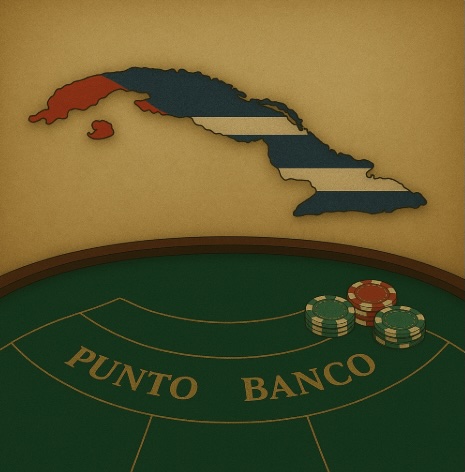
While Europe refined Chemin de Fer, another version of the baccarat game took shape in the Americas. The modern version of Baccarat known as Punto y Banco was born in South America before spreading to casinos in Havana, Cuba. In Cuba during the 19th century, casinos introduced a streamlined version called Punto Banco (“Player-Banker”). When baccarat was brought to Cuba, it was transformed into a pure game of chance, simplifying it from a strategic game where players bet against each other.
Unlike Chemin de Fer, where players could act as the banker, Punto Banco placed the dealer firmly in control of the game. This made it more accessible, requiring less decision-making from players and relying almost entirely on chance. In this baccarat game, both the player's hand and the banker's hand are each dealt two cards, typically dealt face down. The sum of the card values determines the hand's score, and if the total exceeds 9, only the last digit counts. Sometimes, a third card is drawn according to strict rules, impacting the outcome. After each round, the next hand is dealt, and the shoe may pass to the next person or next player, depending on the variant.
From Cuba, Punto Banco spread to South America and then into the United States. In 1959, the rules of Baccarat were standardized, with the banking role moved to the house, which increased game pace and house revenues. Havana’s glamorous casinos were especially influential, hosting Hollywood stars, politicians, and jet-setters in the mid-20th century. Punto Banco was the perfect fit when Las Vegas operators were looking for new games to appeal to their growing clientele in the 1950s.
Several popular variants emerged from this evolution. Mini-baccarat is a smaller version of punto banco that features lower minimum and maximum bets, making it more accessible to casual players. EZ-baccarat is a variant where both winning banker and player bets pay even money, except when the banker wins with a total of 7 after the third card, resulting in a push on banker bets. Baccarat banque is another variant where the banker position is more permanent, and the game is played with three decks of cards, allowing for a more strategic play and involving the rotation of the banker to the next player or next person after certain conditions are met.
Baccarat in Las Vegas: The Game of High-Rollers
In 1959, Las Vegas introduced Punto Banco at the Sands Casino, one of the Strip’s most glamorous venues. Nevada played a pivotal role in legalizing and popularizing baccarat, with its casinos helping to establish the game’s reputation in the US. Though initially met with scepticism, the game quickly gained traction among high rollers.
Americans were instrumental in shaping and popularizing baccarat in the United States, adapting the game to local tastes and casino culture. Vegas operators cleverly marketed baccarat as a game of exclusivity. Unlike blackjack or craps, which filled crowded casino floors, baccarat was tucked away in plush, velvet-roped salons. Dealers wore tuxedos, and minimum bets were set high. Celebrities, oil tycoons, and international visitors gravitated toward the game, eager to bask in its aura of wealth.
In the casino setup, the house acts as the bank, managing bets and setting the rules, which ensures the house edge and controls the gameplay dynamics. Baccarat’s status sky rocketed thanks to Ian Fleming’s James Bond novels and films. In the original Casino Royale (1953 novel, 1967 film, and later Dr. No and Thunderball), Bond famously takes on his enemies at the baccarat table. The imagery of 007 in a tuxedo, martini in hand, facing off against villains under the glow of casino chandeliers cemented baccarat as the epitome of intrigue and espionage.
Even after Bond switched to poker in later films, baccarat retained its identity as “the spy’s game” and “the millionaire’s choice.”
Baccarat in Macau and Asia: The Modern Powerhouse
Today, if there is one place where baccarat truly reigns supreme, it is Macau, the gambling capital of Asia and now recognized as the gambling capital of the world. Since the early 2000s, baccarat has accounted for roughly 90% of all casino gaming revenue in Macau, far surpassing other games. The liberalization of gaming in Macau has established it as the world’s leading gambling destination, with baccarat as the main driving force behind its revenue.
For Asian high-rollers, baccarat carries a deep cultural resonance. Many see it as a game of fate and destiny, aligning with traditional beliefs in luck and fortune. Baccarat’s low house edge and fast pace resonate with Asian cultural preferences, contributing to its immense popularity in Macau casinos. VIP junket operators arrange for wealthy players to be flown into Macau, where they play baccarat in lavish private salons, often betting millions on a single hand.
Casinos like the Grand Lisboa and The Venetian Macau are now synonymous with baccarat’s modern dominance. Here, the game is not just entertainment; it’s an economic engine, fuelling Macau’s status as the world’s most profitable gambling hub.
This Asian chapter in baccarat’s history demonstrates how a game once confined to Italian nobles now drives the global gambling industry.

Baccarat: Online Baccarat, and Baccarat In Pop Culture
Online Baccarat: Bringing Glamour to the Digital Age
As with other casino classics, baccarat embraced the digital revolution. In the 1990s, online casinos introduced baccarat to a new audience, offering RNG (random number generator) versions that replicated the gameplay virtually.
But the real breakthrough came with live dealer baccarat in the 2000s. High-definition streaming, professional dealers, and interactive betting recreated the feel of a real casino table. Suddenly, baccarat players could experience the glamour of Monte Carlo or Macau from their living rooms, just like some of the most notable individuals who have mastered the game.
Online baccarat now caters to both casual players and VIPs. Some platforms even offer private high-stakes live tables, complete with dedicated hosts, echoing the velvet-roped salons of Vegas. Bonuses, free bets, and loyalty programs ensure that baccarat’s luxurious reputation carries into the digital space. Notably, professional gambler Phil Ivey gained notoriety among baccarat players for using an advantage play technique known as edge sorting to win significant amounts at baccarat tables, including a controversial $11 million win. This technique involves exploiting subtle imperfections on the cards to tilt the odds in the player's favor.
Baccarat in Pop Culture: James Bond and Beyond
Beyond James Bond, baccarat has often been portrayed as the game of intrigue, sophistication, and glamour.
· In Casino Royale (1967), Bond’s battle at the baccarat table was one of cinema’s most iconic gambling scenes, brought to life by Ian Fleming, who introduced baccarat as Bond’s game of choice in his novels and left a lasting mark on the game’s image in popular culture.
· In Dr. No and Thunderball, baccarat returns as Bond’s signature game, reinforcing its connection to spies, danger, and luxury.
· Baccarat is often featured in novels and films as a shorthand for wealth and elegance, the game of choice for the world’s elite.
This pop culture presence has ensured that baccarat is not only a game but a symbol of intelligence, glamour, and suspense. Legendary players have also left their mark on baccarat history—Akio "The Warrior" Kashiwagi was renowned for placing the highest-stakes wagers that casinos would accept, while Kerry Packer, the Australian media mogul, was famous for his high-stakes play and his uncanny ability to memorize slight imperfections on cards to guide his wagers.
From its origins in Italy with Felix Falguiere, to French salons and James Bond’s baccarat showdowns, to today’s Macau high-roller suites, baccarat has always been a game of glamour and fortune.
Now you can enjoy the same sophistication online. With live dealer baccarat, mobile play, and exclusive welcome bonuses, the world’s most elegant casino game is just a click away.
www.casinojester.co.uk

OVERVIEW
The history of baccarat is as rich and elegant as the game itself. Born from an Italian myth, refined in the salons of France, scandalized in English society, transformed in Cuban casinos, elevated in Las Vegas, and crowned in Macau, baccarat has continually evolved while maintaining its identity as the most glamorous of casino games.
It has been played by kings, aristocrats, spies, tycoons, and high-rollers. It has starred in literature and cinema, from Cervantes ’Spain to Ian Fleming’s James Bond. And now, it thrives in the digital age, where anyone can log on and play baccarat at a live dealer table, sipping virtual champagne as the cards are dealt.
What makes baccarat timeless is its paradox: a game that is incredibly simple to play, yet endlessly rich in history and glamour. Whether at Monte Carlo’s legendary casino, in a private Macau salon, or online from home, baccarat remains the ultimate expression of casino sophistication.
The wheel of roulette may spin, the craps dice may roll, but for those who crave elegance and destiny in equal measure, baccarat will always be the game of choice.
In Baccarat, there are three classic versions: Punto Banco, Chemin de Fer, and Baccarat Banque.
Baccarat uses eight decks of cards. Card counting can reduce the house edge by about 0.05%.
Winning bets on the banker side incur a 5% commission. Banker bets pay 19-to-20 odds after a 5% commission. The banker bet has a low house edge of 1.06%.
Player bets pay even money at 1-to-1 odds. The house edge for player bets is 1.24%.
If both hands tie, bets remain for the next hand. The tie bet has a high house edge of 14.4%. Tie bets typically pay 8-to-1 odds in most casinos.
Lightning Baccarat adds random multipliers to winnings from matched Lightning Cards.
In No Commission Baccarat, the bank pays 1:1 unless it wins with a specific total.
Choose one of the online casinos from our approved list, grab your bonus, and start playing smarter today.
www.casinojester.co.uk
CJ Guides and Reviews
CJ Baccarat Guides
Beginner's Guide to Baccarat
Beginner’s Guide To Online Baccarat
Beginner’s Guide to Mobile Baccarat
Top 10 Best Tips to Play Better Baccarat
Top 10 Best Books About Baccarat
CJ Live Dealer Guide
Beginner’s Guide To Online Live Dealer Games
CJ Casino Review
Genting Casino Review and Current Offers
Hippodrome Casino Review and Current Offers
10Bet Casino Review and Current Offers
Betway Casino Review and Current Offers
CJ Global Guide
Gambling Growth in Asia
CJ Casino Guide
Beginner's Guide to Casino VIP Comps
Beginner's Guide to Casino VIP Junkets
The History And Evolution Of Casino Chips
The History and Evolution of Casino Playing Cards
The History of Casinos
Casino Architecture
CJ Guides
Guides and Reviews Index
SEPTEMBER 2026
Top Features of UK Online Casinos
Playing at our recommended casinos offers an exciting and secure gaming experience. Enjoy generous online casino bonuses, a wide variety of gaming options, and robust security measures.

UK Regulated, secure & trusted

Huge variety of games, jackpots, free spins & bonuses

All casinos offer Responsible gambling tools

Fast, safe & simple deposits & withdrawals

Good Customer Service

Clear & simple design to ease usability
Trusted by top brands in the industry